Tallahassee & Leon County
Air Conditioner Repair Tallahassee FL
Help when your home stops cooling. Get connected with independent local service providers for residential air conditioner repair, emergency no-cooling calls, maintenance and replacement across Tallahassee and Leon County. Free to use, with requests accepted 24/7.
- Requests taken 24/7
- Residential only
- Tallahassee & Leon County Coverage
Start Here
What Is Your Air Conditioner Doing?
Pick the symptom that matches your home. Each page explains the likely causes, what you can safely check yourself, and when it is time to stop and call.
Real Homeowner Questions
AC Problems Tallahassee Homeowners Ask About
Short answers to the situations that come up most often in Leon County homes, with a fuller guide behind each one.
My AC runs all day but the house won't cool
Constant run time with weak cooling usually points to airflow restriction, a dirty coil, a refrigerant problem or an outdoor unit that cannot reject heat. Check the filter and the outdoor unit for debris, then request help.
Read moreMy house is cool but still feels humid
Removing moisture takes sustained run time. Short cycles, an oversized system, duct or return leaks and a dirty coil all leave a home cool and clammy.
Read moreMy drain pan is full of water
A full pan means the condensate is not draining, usually a blocked line. A float switch may shut the system off to prevent ceiling damage. Turn it off if water is spreading and get it cleared.
Read moreMy AC stopped after a storm
Wait a few minutes after power returns, confirm the thermostat, then check the HVAC breakers and reset a tripped one only once. If it trips again, leave it off and call.
Read moreMy electric bill suddenly jumped
A sharp increase without a weather change often means the system is running far longer than it should — restricted airflow, a failing component, duct losses or a thermostat problem.
Read moreOne bedroom won't cool
A single hot room is usually a distribution problem: a crushed or disconnected duct branch, a leaking run in a hot attic, a blocked return or an undersized branch.
Read moreI'm being told I need a new system
Ask for the diagnosis in writing and weigh it against repair history, coil condition, refrigerant behavior and duct condition. A single routine part failure rarely justifies replacement.
Read moreWhat temperature should I actually set it to?
In a humid climate, a steady setpoint the system can hold usually beats deep setbacks that force long recovery runs in the afternoon heat.
Read moreAre there rebates for a new AC here?
Local utility and federal energy programs change over time. Verify current terms directly with the utility or program before counting on any amount.
Read moreBefore You Call
Six Safe Things to Check First
None of these require tools, opening equipment panels, or touching wiring. If anything looks or smells wrong, stop and call instead.
- 1
Check the thermostat
Confirm it has power, is set to COOL, and the setpoint is below the current room temperature. Replace the batteries if the display is dim or blank.
- 2
Look at the air filter
A heavily loaded filter restricts airflow enough to weaken cooling and freeze a coil. Replace it if light does not pass through easily.
- 3
Check supply and return vents
Make sure registers are open and nothing — furniture, rugs, storage — is blocking the return grille.
- 4
Look at the outdoor unit
From a safe distance, check that the fan is spinning and that leaves, pollen, mulch or vines are not packed against the coil.
- 5
Check the HVAC breakers
There is usually one for the indoor unit and one for the outdoor unit. A tripped breaker may be reset once, and only once.
- 6
Look for water or ice
Check for standing water in the drain pan, staining on a ceiling below an attic unit, or ice on the coil or refrigerant line. Any of these means shut the system off and call.
Stop and call right away if you notice
Burning smells, smoke, sparking, loud grinding, a breaker that trips again after one reset, water near electrical components, or ice covering the coil or refrigerant line. Never open equipment panels or handle refrigerant, capacitors, contactors or any energized electrical component.
Quick Diagnostic
Why Is the House Still Hot?
Find the description that matches what your system is doing right now.
If this is you
The system runs constantly and air from the vents feels barely cool
Often points to: airflow restriction, a dirty coil, refrigerant issues or a struggling outdoor unit
Runs but won't coolIf this is you
Nothing happens at all — no indoor blower, no outdoor fan
Often points to: a tripped breaker, a thermostat with no power, a float switch, or a control failure
AC won't turn onIf this is you
Air from the vents is warm even though the thermostat is calling for cooling
Often points to: an outdoor unit not running, a contactor or capacitor fault, or a refrigerant problem
Blowing warm airIf this is you
The temperature is fine but the house feels damp and sticky
Often points to: short cycling, oversizing, duct or return leaks, or a dirty coil
Humidity problemsIf this is you
Most of the house is comfortable but one or two rooms stay hot
Often points to: duct leaks in the attic, a crushed or disconnected branch, or a blocked return
Duct and airflowIf this is you
There is ice on the coil or on the copper line at the outdoor unit
Often points to: restricted airflow or low refrigerant — shut it off before running it further
Frozen coil24/7 Emergency Requests
No Cooling in a Tallahassee Summer Is Not a Wait-Until-Monday Problem
Indoor temperatures climb fast when humidity is high and the heat index sits above 100. If your home has lost cooling entirely, or you smell something burning, calling is faster than waiting for a callback. Availability depends on provider participation, service area, demand and appointment capacity.
Residential Services
Residential AC Services Available in Tallahassee
AC Repair
Diagnosis and repair of residential cooling failures, from weak airflow to a system that has stopped entirely.
Learn moreEmergency AC Repair
After-hours and weekend requests when a Tallahassee home has lost cooling during dangerous heat.
Learn moreAC Maintenance
Seasonal tune-ups that catch weak capacitors, dirty coils and clogged drains before a July breakdown.
Learn moreHeat Pump Repair
Cooling and heating faults on the heat pumps common throughout Leon County homes.
Learn moreAir Handler Repair
Blower motors, control boards and coil issues inside the indoor unit in your closet, attic or garage.
Learn moreCondensate Drain Line
Clogged condensate drains and overflow shutoffs are common residential AC problems during Tallahassee's humid cooling season.
Learn moreMini Split Repair
Ductless systems in additions, garages, sunrooms and converted spaces.
Learn moreAC Replacement
When repeated repairs on an aging system stop making financial sense.
Learn moreHow Your System Works
The Four Parts of a Home Cooling System
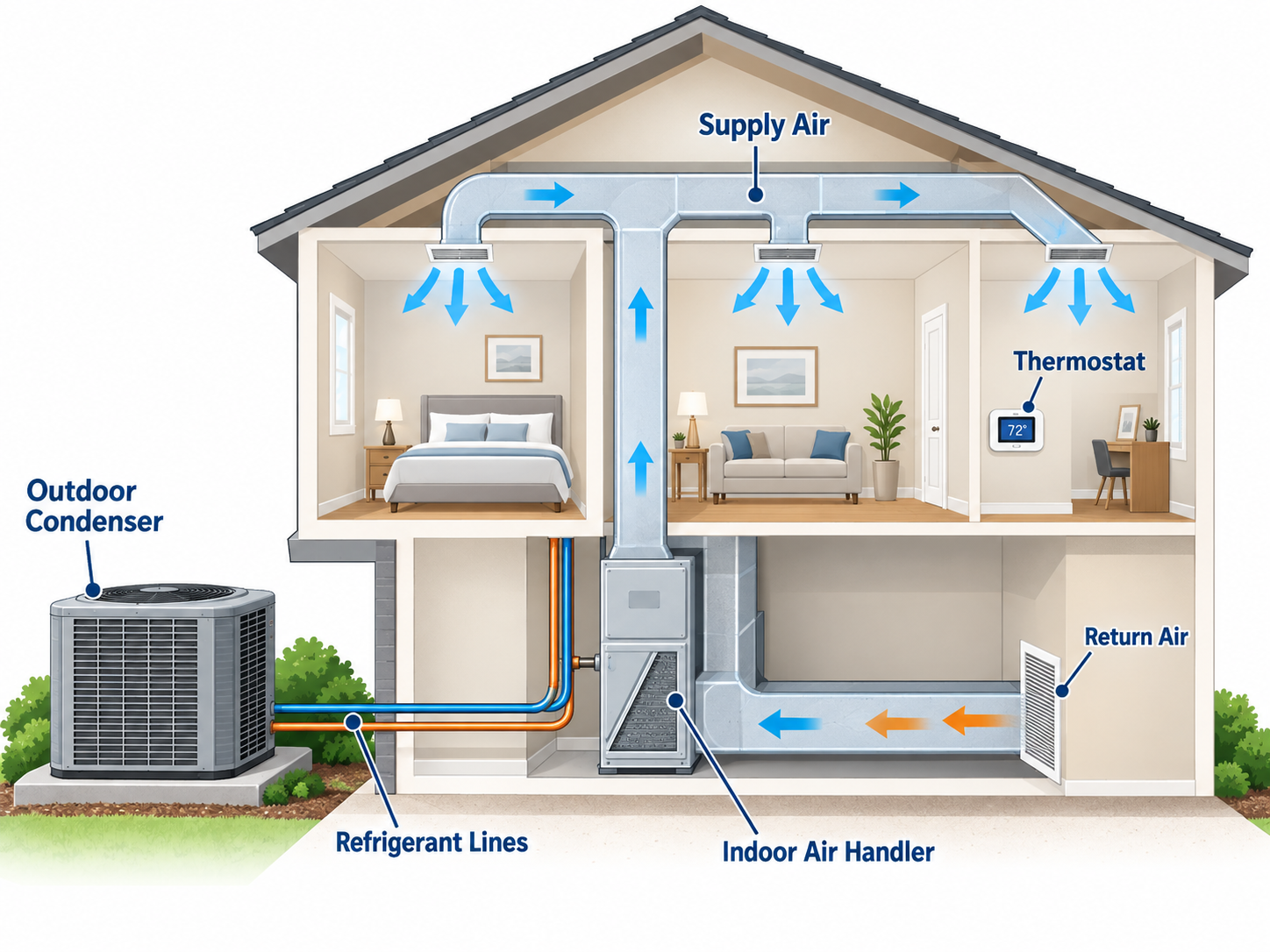
Almost every no-cooling call traces back to one of four places. Knowing which part is which makes it far easier to describe your problem accurately and to follow what a provider tells you.
- Outdoor condenser
- The unit beside your house. It rejects heat outdoors and contains the compressor, fan and capacitor.
- Refrigerant lines
- The insulated copper pair carrying refrigerant between outdoor and indoor equipment.
- Indoor air handler
- Blower, evaporator coil and filter — usually in a closet, attic or garage. Where ice and drain clogs show up.
- Thermostat and ducts
- The control that calls for cooling, and the supply and return paths that move air through the house.
Local Conditions
Why Tallahassee Is Hard on Residential Air Conditioners
Tallahassee sits in a humid subtropical climate where cooling season stretches from early spring into October. Systems here do not get the long off-season that equipment in other regions enjoys, so component wear accumulates faster.
High dew points mean your evaporator coil pulls gallons of water out of the air every day, and that water has to leave through a condensate drain. In shaded, pollen-heavy neighborhoods those drains clog with biological growth, which is why overflow switches shut systems down mid-summer across Leon County.
Summer thunderstorms add a second pattern: power flickers and surges that trip breakers, scramble thermostats and stress contactors and control boards. After a storm it is common for a system to look dead when the actual issue is upstream of the equipment.
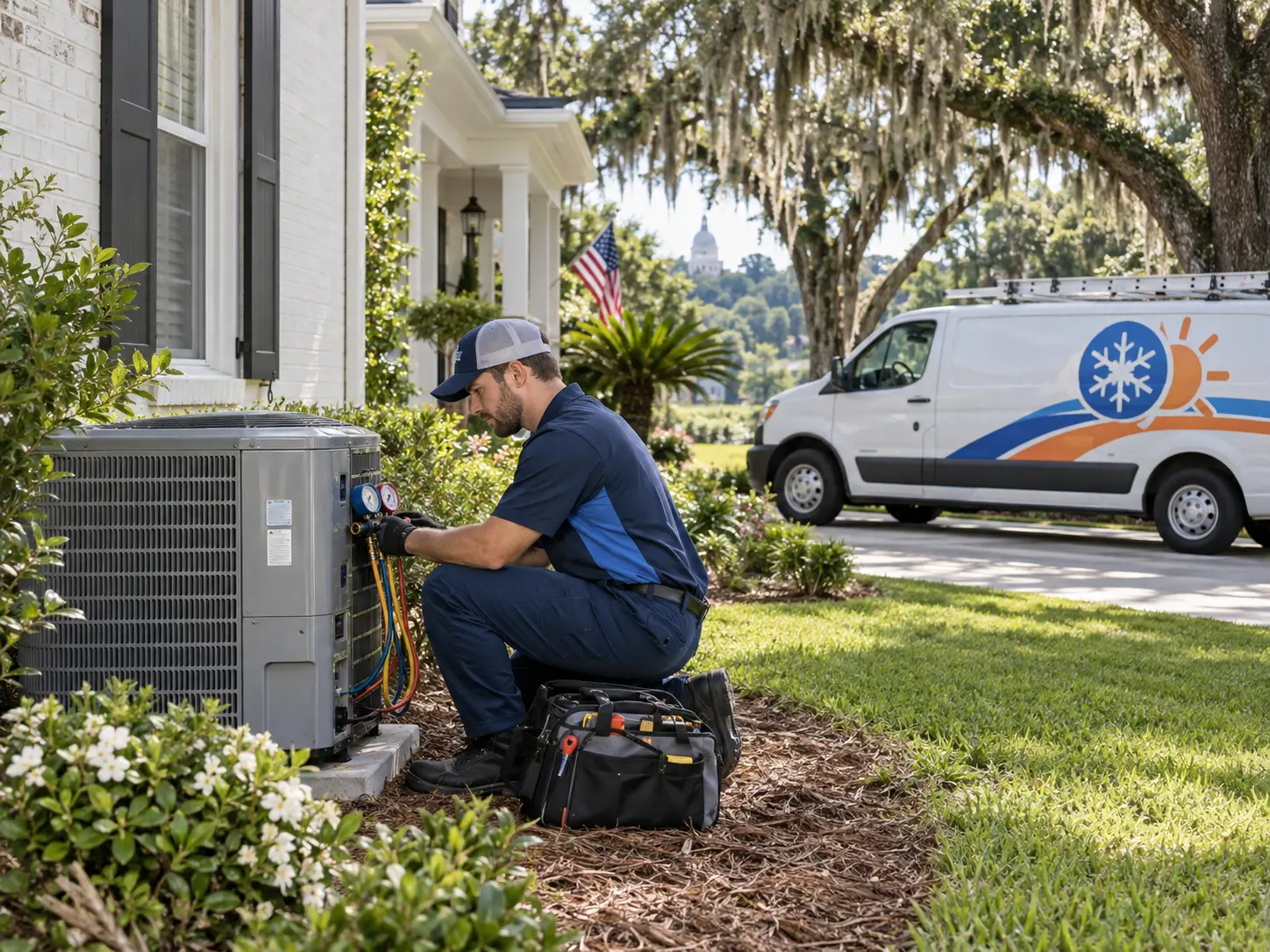
Heavy oak canopy and Spanish moss keep many yards cool and shaded, but they also drop debris into outdoor condenser coils. A coil packed with leaf litter and pollen cannot reject heat, which raises pressures, raises energy use and shortens compressor life.
How It Works
Three Steps to Getting Your Home Cool Again
1. Tell us what's happening
Call or send a short description — what the system is doing, how long it has been going on, and your ZIP code.
2. Get connected locally
Your request can be routed to an independent local service provider covering your part of Tallahassee.
3. Talk directly with the provider
The provider handles scheduling, diagnosis and pricing with you directly. You decide whether to move forward.
Service Areas
Neighborhoods We Cover Around Tallahassee
Where We Are
Serving Homeowners Across Tallahassee
Based in northeast Tallahassee and connecting homeowners with independent local service providers across Leon County.
Air Conditioner Repair Tallahassee FL
1334 Timberlane Rd, Room #489
Tallahassee, FL 32312
850-790-6261Homeowner Guides
Understand the Problem Before You Spend a Dollar
Frequently Asked Questions
Requests are accepted 24 hours a day, and many are connected with an independent local service provider the same day. Actual timing depends on provider participation, your service area, technician availability and how busy the market is during a heat wave or after a storm.
Request Service
Send Your AC Problem to a Local Provider
Share a few details and your request can be connected with an independent local service provider. If your home is dangerously hot right now, calling is faster.
Request AC Service
Share a few details and get connected with an independent local service provider based on availability.