
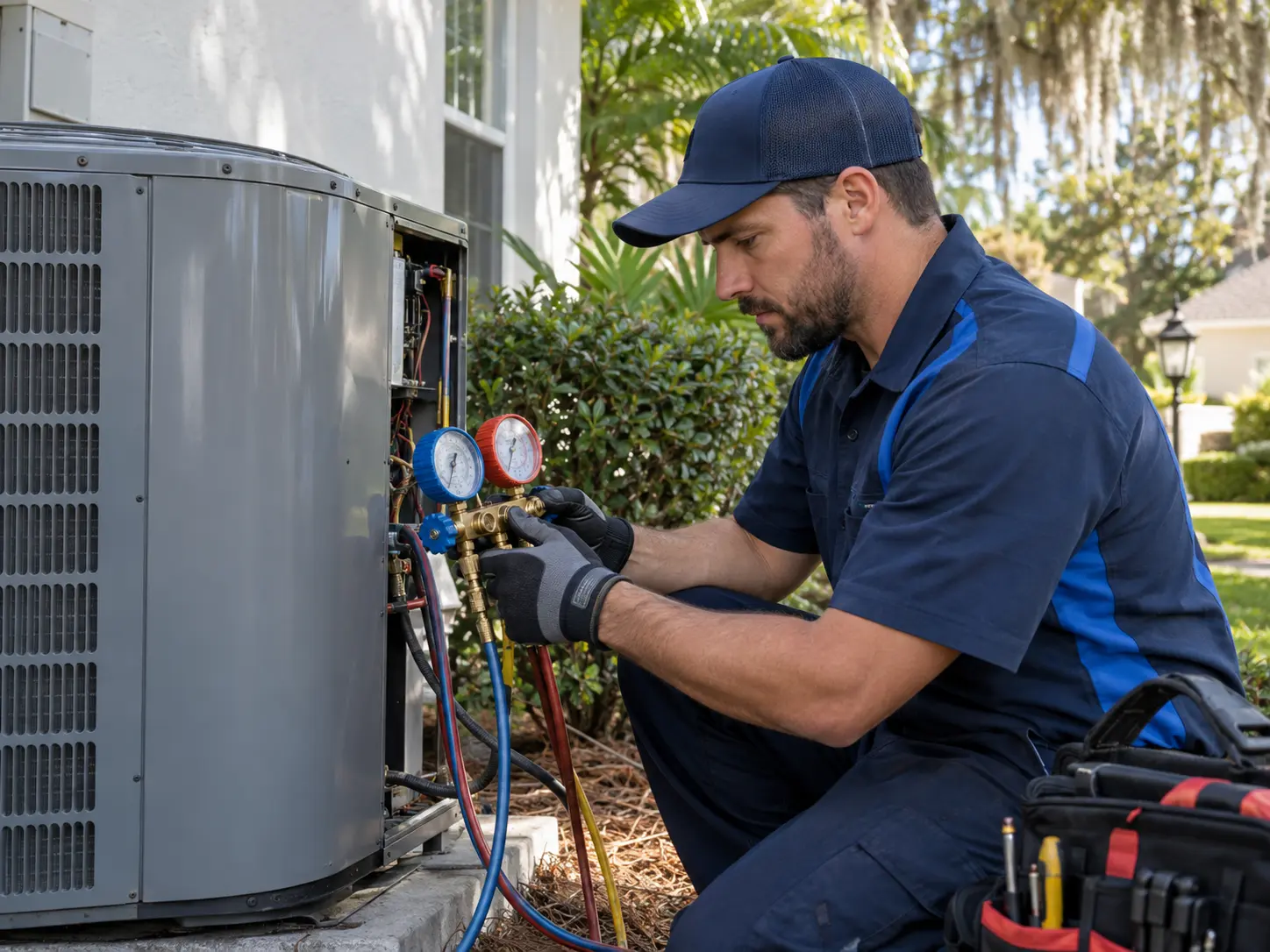
Airflow problems that quietly cut capacity
A cooling system removes heat from air that passes over the indoor coil. Reduce that airflow and capacity falls even though the equipment sounds completely normal.
- A dirty air filter, which loads up quickly during pollen season and long run times.
- Closed, blocked or furniture-covered supply registers.
- A restricted return-air path — a blocked return grille, a filter grille packed with dust, or an undersized return for the equipment.
- A dirty evaporator coil that air cannot pass through freely.
- A blower wheel coated with dust, or a blower motor running at the wrong speed.
Outdoor unit and heat rejection
Heat picked up indoors has to leave the house through the outdoor condenser. In shaded Killearn Estates and Betton Hills yards, coils fill with leaf litter, grass clippings and pollen, and a coil that cannot breathe cannot reject heat.
If the indoor blower runs but the outdoor condenser is silent, possible causes can include a tripped breaker, a failed capacitor, a contactor problem, a condenser fan issue, a thermostat or control problem, or a compressor-related failure. Those are diagnostic items for a qualified provider, not homeowner repairs.
- Dirty or debris-packed condenser coil.
- Condenser fan not turning, or turning slowly.
- A weak capacitor, which can let a motor struggle or stop under heat.
- A compressor that is running but no longer pumping effectively.
Refrigerant and coil temperature
Refrigerant is not consumed. If a charge is low, it left through a leak, and adding more without finding the leak only delays the same failure.
Low charge shows up as long run times, weak cooling and sometimes ice on the indoor coil or the larger copper line. Refrigerant work is licensed work — homeowners should never open, vent or add to a refrigerant circuit.
A frozen evaporator coil
Ice on the indoor coil blocks airflow completely, so the system runs endlessly while delivering almost nothing at the vents. Ice is a symptom of restricted airflow or low refrigerant, not a cause on its own.
If you see ice on the coil or the refrigerant line, turn the cooling off at the thermostat and leave the fan on AUTO. Continuing to run a frozen system can send liquid refrigerant back to the compressor.
Duct leakage and distribution
Many Tallahassee homes have ducts in a hot attic. A supply leak dumps cooled air where nobody lives; a return leak pulls superheated attic air into the system, which is why a house can stay warm and humid at the same time.
Crushed flex duct, a disconnected run above a ceiling, and poorly balanced airflow all produce the same complaint: the system runs constantly and some rooms never catch up.
Thermostat, sizing and heat load
- A thermostat located on a wall in direct sun, near a lamp or above a supply register can misread the house.
- A failing thermostat or a wiring fault can leave the system calling for cooling without proper staging.
- An undersized or deteriorating system loses capacity gradually; the same equipment that used to hold 74 may now hold 78 on the hottest afternoons.
- Unusually high heat load — a heat index above 100, west-facing glass with no shading, attic insulation that has settled, or extra people and appliances in the home.
What Can You Check Safely?
These checks involve no tools, no panels and no electrical components. Stop at any point where something looks or smells wrong.
- 1Confirm the thermostat is set to COOL, not HEAT or OFF.
- 2Confirm the setpoint is actually below the current room temperature, and give it a reasonable target rather than dropping it to 65.
- 3Set the thermostat fan to AUTO rather than ON.
- 4Look at the air filter. If it is grey, matted or blocking light, replace it with the same size.
- 5Walk the house and confirm supply vents are open and not blocked by furniture or rugs.
- 6Look at the indoor unit and the copper lines for visible ice. If there is ice, switch cooling off and let it thaw.
- 7Step outside and confirm the outdoor unit is running and the fan on top is spinning.
- 8Check whether the HVAC breaker has tripped. If it has, it may be reset once — never repeatedly.
Do not keep resetting a breaker
A breaker that trips again after one reset is doing its job — it is reporting a fault in the equipment or the circuit. Repeated resets can turn an electrical fault into a fire or a destroyed compressor.
If the breaker trips a second time, if you smell burning, or if you hear buzzing, grinding or sparking, leave the system off and request professional help.
AC Still Running Without Cooling?
If the safe checks above did not change anything, the next step is a diagnosis by an independent local service provider. Call 850-790-6261 any hour, or send a short description of what the system is doing and your ZIP code.
It helps to note when the problem started, whether the outdoor unit runs, whether air at the vents feels cool at all, and whether anything changed after a storm.
Need Help With This Today?
Call for 24/7 residential AC help in Tallahassee, or send a short description of what your system is doing.
Frequently Asked Questions
During long stretches of 90-plus degree days with high humidity, extended run time is normal — residential equipment is sized to hold a setpoint, not to cycle briefly in extreme heat. What is not normal is running all day while the indoor temperature climbs or holds well above the setting.