
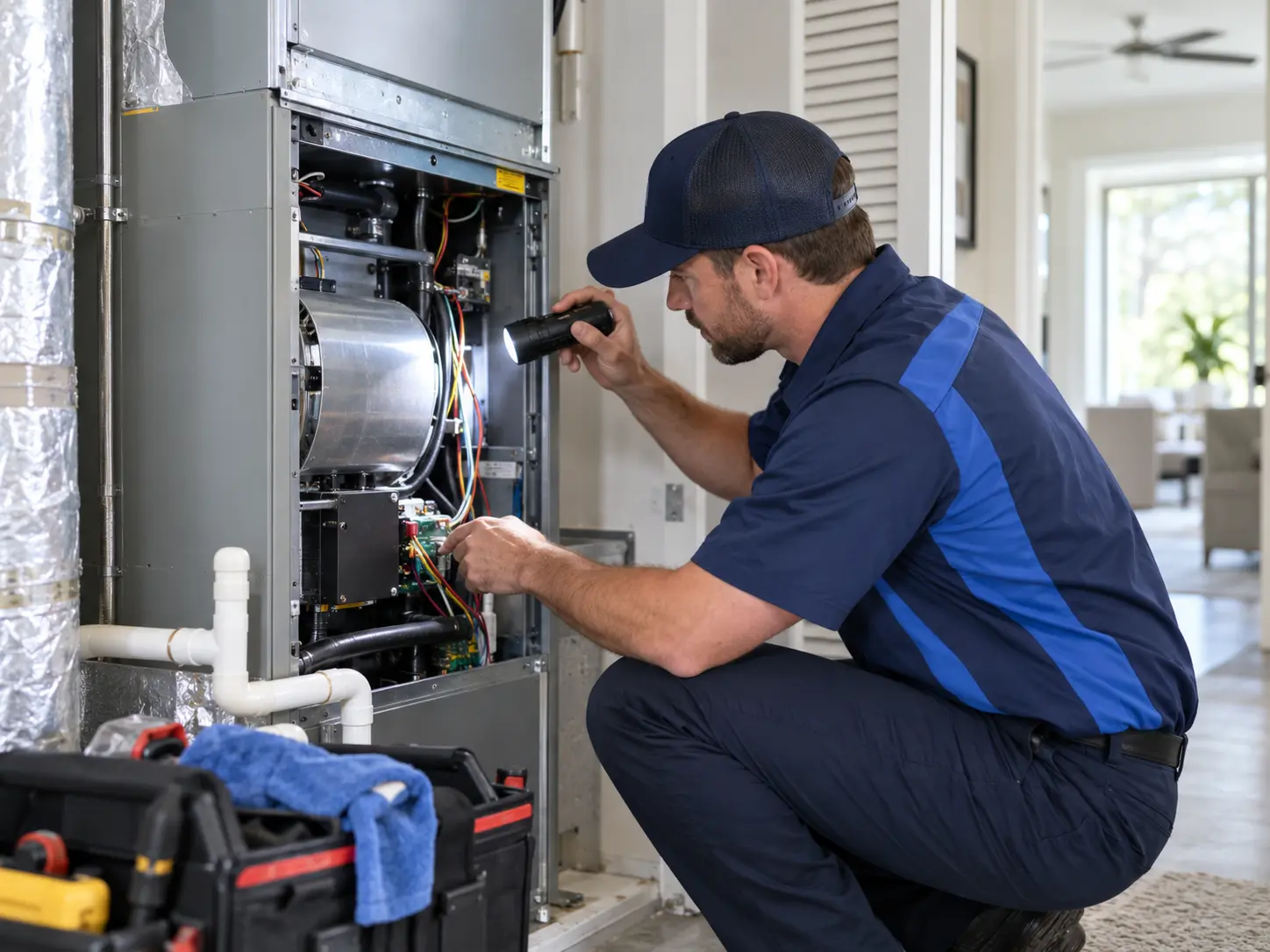
Common air handler problems
- Blower motor failure or a motor that runs intermittently.
- Failed blower capacitor or ECM motor module.
- Dirty blower wheel, which can cut airflow dramatically without any obvious noise.
- Dirty evaporator coil restricting both airflow and heat transfer.
- Cracked or disconnected duct connections at the plenum.
- Control board faults, especially after storm-related power events.
- Clogged condensate pan and drain, tripping the float switch.
- Rattling panels, loose blower wheels or worn bearings producing noise.
Why airflow is the quiet problem
Airflow issues rarely announce themselves. A system can lose a substantial share of its designed airflow through a dirty coil and a partially collapsed return without ever making a strange noise.
The visible results are what homeowners report: rooms that never cool evenly, high humidity, longer run times, and occasional freezing.
Attic and closet installations
In much of Tallahassee's 1990s and later housing stock, the air handler lives in the attic. Attic installations run in extreme heat, and duct leakage there costs real capacity because leaked supply air is lost to a 130-degree space.
Closet installations are easier to service but tighter on return air, and a restrictive return grille is a frequent contributor to poor performance.
What a provider typically checks
- Blower operation, amp draw and speed configuration.
- Static pressure across the system to quantify restriction.
- Coil and blower wheel cleanliness.
- Condensate pan, drain and float switch function.
- Duct connections, insulation and obvious leakage.
Need Help With This Today?
Call for 24/7 residential AC help in Tallahassee, or send a short description of what your system is doing.
Frequently Asked Questions
System-wide weak airflow usually means a restriction near the equipment — filter, coil, blower wheel or return duct — rather than a problem with individual registers.