
Symptoms that point toward airflow
- One room is much hotter than the rest of the house, often a bonus room or an addition.
- Weak air from some vents while others feel strong.
- The system runs constantly and still struggles to reach the setpoint.
- The house feels humid even when the temperature is acceptable.
- Electric bills rise without a change in habits or weather.
- Excessive dust settling shortly after cleaning.
- A noisy return grille that whistles or roars when the blower starts.
- Whistling or rushing sounds around ceiling or wall registers.
What causes restricted or lost airflow
- A dirty air filter — the single most common cause and the easiest to rule out.
- A blocked return grille, or furniture placed against a return.
- Damaged duct, crushed or kinked flex duct, or a run sagging across an attic truss.
- A duct disconnected at a boot or plenum, dumping conditioned air into the attic.
- Leakage at joints and connections that were never properly sealed.
- Return-air leakage pulling hot, humid attic air into the system.
- A dirty evaporator coil restricting the air path.
- A blower wheel loaded with dust, a failing blower motor, or an incorrect speed setting.
- Airflow that was never balanced between floors, wings or additions.
Why Return-Air Problems Matter
Supply ducts get the attention because that is where the cool air appears. The return side is what feeds the system: it pulls house air back across the evaporator coil so heat and moisture can be removed.
When a return is restricted, the blower cannot move its rated airflow. Coil temperature drops, capacity falls, and in bad cases the coil ices over and the system stops cooling entirely.
When a return leaks — a panned floor joist, an unsealed platform under an air handler, a gap at the filter grille — the system draws in attic or crawlspace air instead of house air. That air is hotter and far more humid than what it replaced, which is why a return leak often shows up as a clammy house rather than a warm one.
How to picture your system
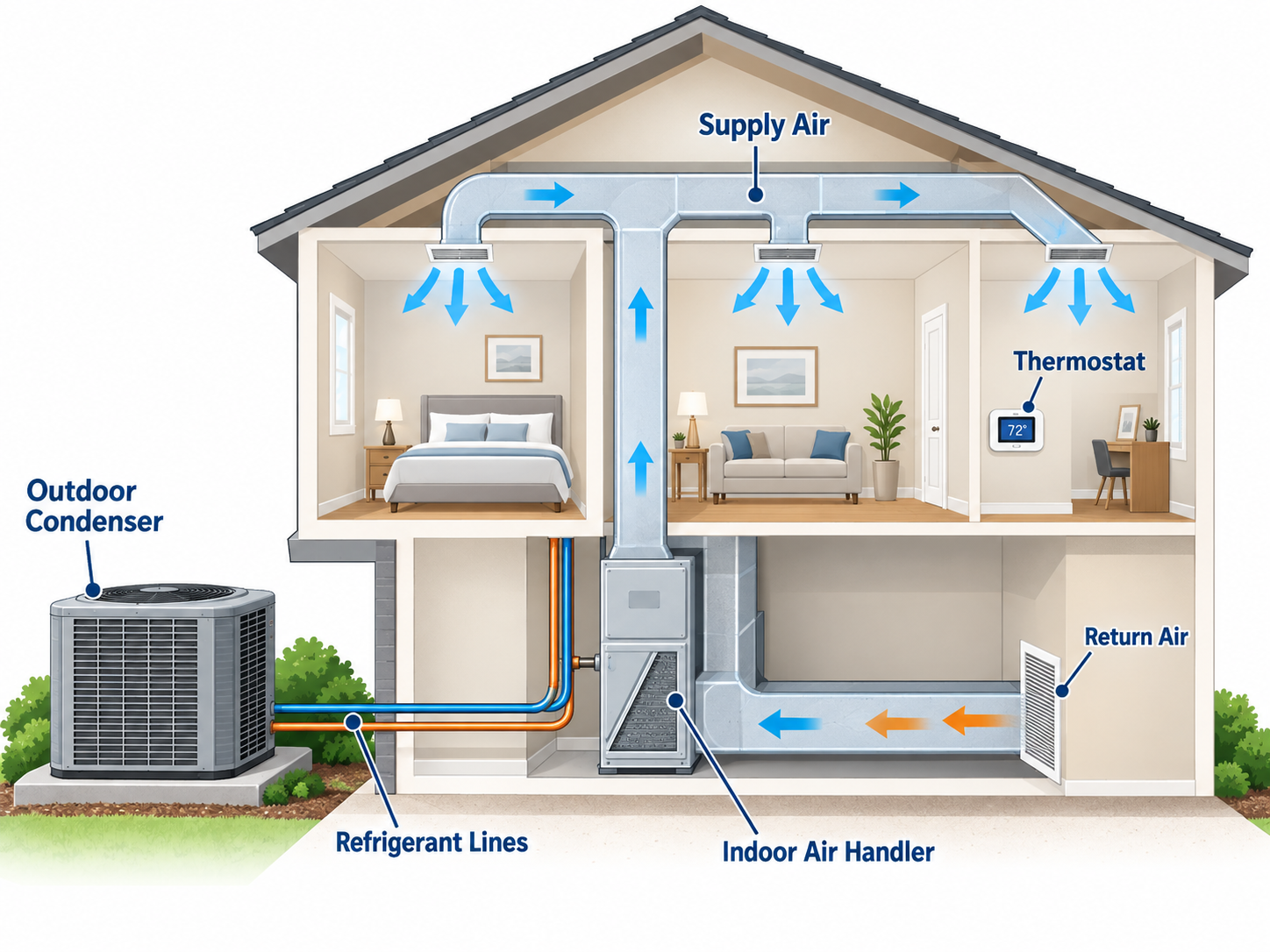
Return air travels to the indoor air handler, passes across the evaporator coil, and is pushed back out through the supply ducts. Refrigerant lines carry the collected heat to the outdoor condenser, where it leaves the house.
Any restriction on that loop reduces comfort everywhere, not just in the room where you notice it.
Why one room stays hotter than the rest
A single warm room usually has a distribution explanation rather than an equipment one. Long duct runs to a far bedroom off Thomasville Road, an addition tied into an already-loaded trunk line, or a bonus room over a garage with attic exposure on five surfaces all lose the fight in August.
Solar gain matters too. A west-facing room with large windows can carry several degrees of extra load in the late afternoon even with perfect airflow.
- Confirm the supply register in that room is open and unobstructed.
- Check whether the door is usually closed and whether the room has any return path.
- Note whether the problem is all day or only in the afternoon.
- Have duct condition, register sizing and airflow balance evaluated if the pattern is year after year.
What a provider evaluates
- Filter condition, filter sizing and the condition of the return grille.
- Static pressure across the system, which reveals restriction the eye cannot see.
- Duct condition in the attic or crawlspace, including disconnections and crushed sections.
- Coil and blower cleanliness, and blower speed configuration.
- Register and return sizing relative to the equipment.
- Airflow balance between rooms, floors and additions.
Need Help With This Today?
Call for 24/7 residential AC help in Tallahassee, or send a short description of what your system is doing.
Frequently Asked Questions
Yes. A crushed or disconnected duct, a run that is too long or too small, or an addition tied into an overloaded trunk line will leave one room short of air while the rest of the house is comfortable.