
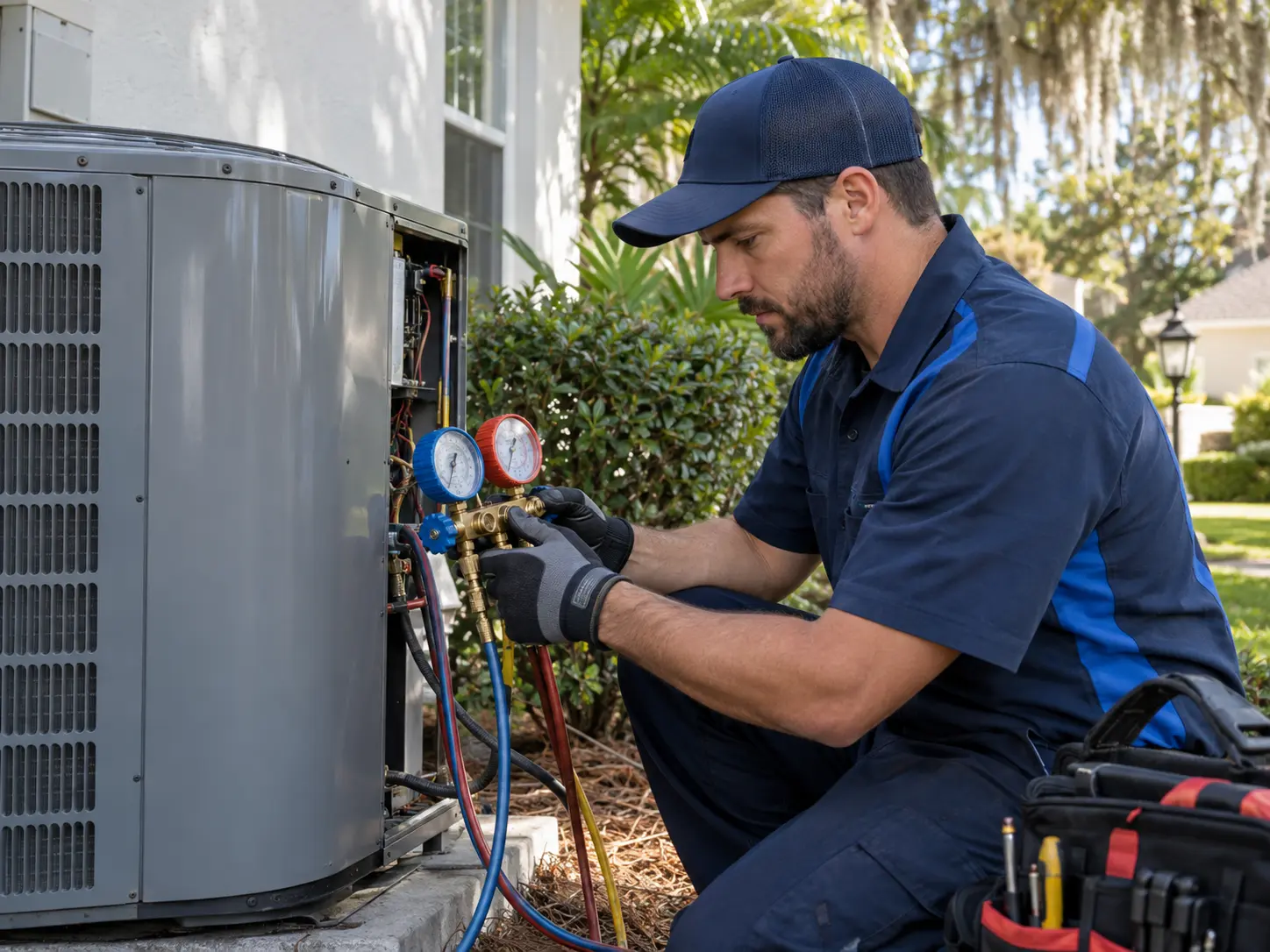
Why an air conditioner runs but doesn't cool
- Dirty filter — the single most common cause, and the easiest to rule out.
- Thermostat setting or fault — fan set to ON instead of AUTO makes supply air feel warm between cycles; a failing sensor can misread room temperature.
- Restricted airflow — closed or blocked registers, crushed flex duct, or a dirty blower wheel.
- Dirty outdoor coil — pollen, grass clippings and leaf litter blanket the condenser and prevent it from rejecting heat.
- Failing capacitor or contactor — the compressor may not start, or may start and drop out on overload.
- Condenser fan not turning — head pressure climbs quickly and cooling collapses.
- Low refrigerant from a leak — capacity drops, run times stretch, and the coil may frost.
- Frozen evaporator coil — ice blocks airflow, so almost nothing cold reaches the rooms.
- Clogged condensate system — a full pan trips the safety switch and cuts cooling.
- Compressor problems — the system runs but no longer compresses effectively.
- Duct losses — supply air cooled to 55 degrees can arrive at a far-off bedroom much warmer after traveling through a 130-degree attic.
- Equipment condition and sizing — an aging or poorly matched system may simply be unable to keep up during peak load.
What you can check before calling
- Set the thermostat to COOL, the fan to AUTO, and the setpoint at least three degrees below the current room temperature.
- Replace the filter if it is grey, matted, or you cannot remember the last change.
- Walk the house and open supply registers; do not close vents in unused rooms as a savings strategy.
- Look for ice on the copper lines at the outdoor unit or on the indoor coil.
- Go outside and confirm the fan is spinning and the unit is not just humming.
- Rinse loose debris off the outdoor coil fins with a garden hose from the outside in — no pressure washer.
How Tallahassee conditions change the picture
On a 96-degree afternoon with high humidity, a system that has lost even 15% of its capacity will fall behind noticeably. The same shortfall in April goes unnoticed, which is why so many no-cooling calls arrive the first truly hot week of the season.
Homes in older neighborhoods such as Betton Hills and Midtown often combine original duct routing with newer equipment, and the ductwork frequently becomes the limiting factor rather than the condenser.
When to stop troubleshooting and get help
If the filter is clean, the thermostat is set correctly, the outdoor fan is running, and the house still will not cool, the remaining causes require gauges, meters and training to diagnose safely.
Turn the system off and request help if you see ice, smell anything burning, notice water around the air handler, or hear the breaker trip.
Measure the temperature split
Hold a thermometer at a supply register near the air handler, then at the return grille after the system has run about 15 minutes. A healthy residential system typically shows a 16 to 22 degree difference.
A small split with strong airflow points toward a refrigerant or compressor issue. A large split with weak airflow points toward a restriction. That single measurement narrows the field quickly before anyone opens a panel.
Why the house can stay warm even when the AC is working
- Duct leakage into a hot attic, so supply air is lost before it reaches the rooms.
- Thin or displaced attic insulation adding load faster than the system can remove it.
- Large west-facing glass driving heavy afternoon heat gain.
- Equipment undersized for the actual load, or oversized and short cycling.
- Extreme outdoor temperatures pushing an aging system to its capacity limit.
Repair versus replacement considerations
Poor cooling caused by a capacitor, contactor, fan motor or blocked coil is straightforward repair territory. Poor cooling caused by a refrigerant leak in an aging coil, or by a compressor that no longer pumps well, is where the conversation shifts.
Worth weighing: how many repairs the system has needed recently, whether it still controls humidity, its energy use compared with previous summers, and the refrigerant it uses.
Need Help With This Today?
Call for 24/7 residential AC help in Tallahassee, or send a short description of what your system is doing.
Frequently Asked Questions
Continuous run time with poor cooling usually means restricted airflow, a dirty condenser coil, low refrigerant, or a compressor that is no longer performing. Start by checking the filter and confirming the outdoor fan is spinning.